India’s digital economy is growing fast but its true impact will be felt in something far more intimate than GDP numbers: who gets access to the new world of work, and who is left behind.
With mobile connectivity nearing scale, government services moving online, and a surge in platform-based work, the digital economy is no longer a separate sector. It is becoming the foundation layer through which work is organised, delivered, and valued across industries. Projections estimate that India’s digital economy could reach $1 trillion by 2029, and its share of the economy could rise from 11.74% of GDP in 2022–23 to nearly 20% of GVA by 2029–30. What stands out even more is its productivity: output per worker in the digital economy is already nearly five times higher than in the broader economy.
But alongside this opportunity sits a critical question: will women be able to participate meaningfully in this transformation and will that participation translate into empowerment?
This blog unpacks early insights from Sanmati 2.0, a research and action initiative by the Gender x Digital Hub (LEAD at Krea University) and The/Nudge, which aims to understand disruptive and scalable models that can increase women’s participation across India’s evolving digital value chain. Building on existing frameworks and consultations with organisations and workers, Sanmati 2.0 offers a lens to decode the digital work landscape and identify where interventions can truly move the needle.
India’s digital economy: the scale of change
India’s digital transformation is being driven by scale: over 1.2 billion mobile connections and more than 900 million internet users, alongside the rapid digitisation of sectors like government services, finance, health, agriculture and education. In just one decade, digital technologies have begun shaping not only how people communicate and transact, but also how they find work, access services, and build livelihoods.

As Sanmati 2.0 notes, this transformation is not driven by one force alone. Three inter-linked shifts are reshaping how work is created, accessed, and valued.

Why women aren’t fully participating (yet)
Female labour force participation in India has risen to 41.7% (PLFS 2023–24), but women’s work remains largely concentrated in informal and self-employed roles. Structural barriers continue to shape what work women can do, where they can work, and how much they can earn.
Occupational segregation pushes women into low-growth sectors, while salaried employment has expanded slowly. At the same time, the nature of jobs is shifting, with limited demand for the skilled labour of “moderately educated” women. These challenges are compounded by unpaid care responsibilities, mobility restrictions, and social norms that constrain women’s choices and daily schedules. The traditional labour market often fails to offer the flexibility many women need, forcing them to choose between paid work and unpaid domestic and care responsibilities.
In this context, the digital economy offers both promise and risk. It can open up flexible work, remote opportunities, and new market linkages but without intentional design, it can also reproduce existing inequalities, keeping women concentrated in low-value roles and excluded from the fastest-growing segments of the digital value chain.
A new lens on digital jobs: Sanmati 2.0’s work models
Against this backdrop, Sanmati 2.0 proposes a clear framework to understand where women can participate in the digital economy and what it will take to enable meaningful progression.
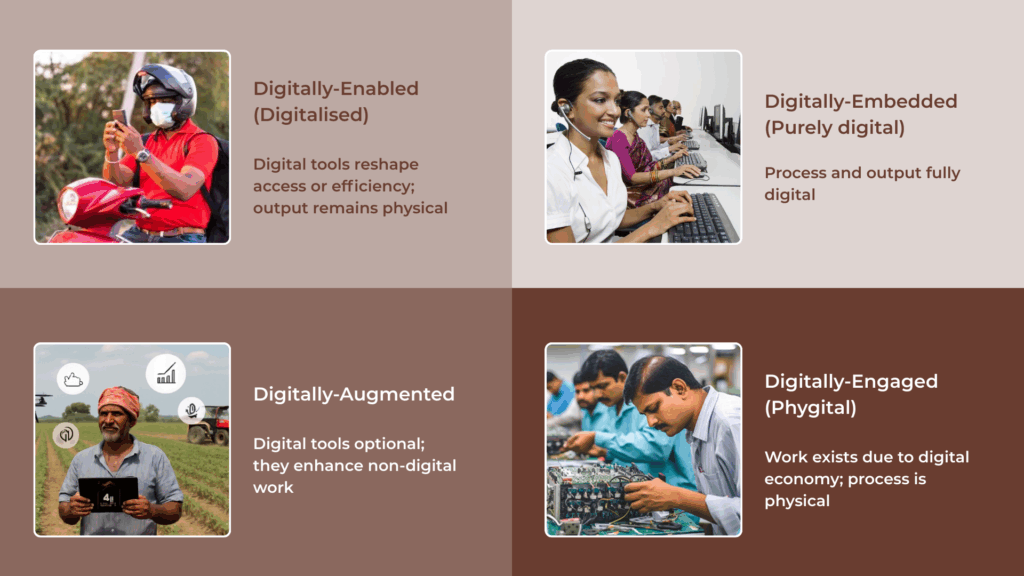
The framework categorises digital work into four models based on how essential digital tools are to the work process and output: digitally enabled, digitally engaged, digitally embedded, and digitally augmented work.
Why digital work can still exclude women
Across these work models, women’s participation is constrained by persistent barriers such as device access gaps, low connectivity, weak market linkages, and the concentration of women in low-value roles. Digital safety and online harms are rising, especially as more roles move fully online. Regulatory protections and workplace support systems remain uneven, and social norms continue to restrict what work women can take on and sustain.
Key barriers women face:

What needs to change: from access to empowerment
Sanmati 2.0’s central takeaway is that increasing women’s participation is not enough. The goal must be empowerment, ensuring women not only enter the digital economy but progress, earn fairly, and work safely.
While the specific levers will vary across work models, the intent is consistent: women must be able to access opportunities, stay engaged safely, and progress into higher-value roles across the digital value chain.
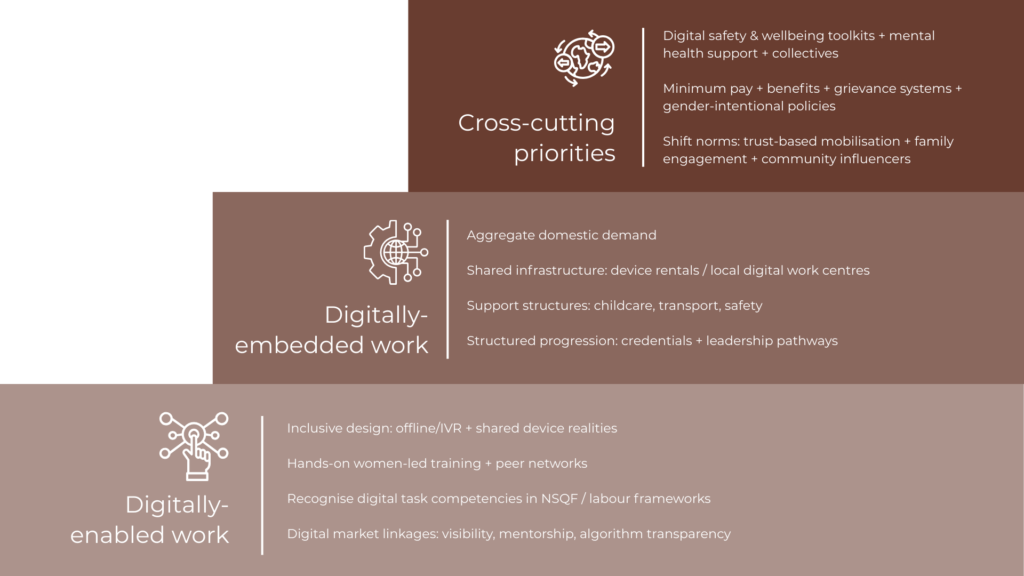
In digitally enabled work, the focus must be on inclusive tool design that accounts for shared device use and intermittent connectivity, including offline and IVR options. Women also need hands-on, job-relevant training, ideally women-led and supported through peer networks. Finally, national labour and skill frameworks must expand to recognise digital task-based competencies in frontline and community roles, improving visibility and progression.
In digitally embedded work, scaling women’s participation requires mechanisms for aggregating domestic digital demand, access to shared infrastructure such as device rentals or local common work centres near women’s homes, and supportive systems such as childcare and safe transport. Equally important is progression: interoperable credentials, structured upskilling and leadership pathways that enable women to move into intermediate and advanced roles.
Across all categories, empowerment requires cross-cutting priorities: digital safety and wellbeing, minimum pay standards and grievance mechanisms, gender-intentional workplace supports, and interventions that address social norms through family engagement and trust-based mobilisation.
Making digital work work for women
Designing for inclusion: the opportunity ahead
India’s digital economy is expanding rapidly and reshaping how work is created, distributed, and valued. But inclusion will not happen by default. For women to benefit meaningfully, the digital economy must be designed with intention through inclusive infrastructure, safe digital environments, recognised skills, and clear pathways for progression.
Sanmati 2.0 offers a timely lens for this moment. By mapping digital work into distinct models, it highlights where women are entering the digital value chain and where targeted interventions can unlock mobility and growth. Most importantly, it reminds us that participation is not the end goal. Empowerment is.
The opportunity is enormous. With deliberate investment and thoughtful ecosystem design, India can ensure women are not only part of the digital transformation but are positioned to shape it.